Products / Outdoor Temperature & Humidity Sensor
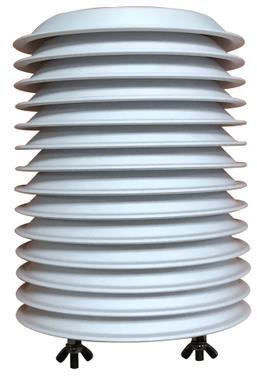
The louvred-screen (Stevenson screen) temperature and humidity sensor provides a calibrated digital output. It applies industrial CMOS process micromachining technology to ensure high reliability and excellent long-term stability. The sensor combines a capacitive polymer humidity element and a band-gap temperature element with a 14-bit A/D converter and serial interface circuit on the same chip, and each unit is calibrated in a humidity calibration chamber. It offers excellent quality, fast response, strong interference immunity and high cost-effectiveness, and is widely used in meteorology, marine, environmental, airport, port, laboratory, agricultural and transport applications.
| Parameter | Value |
|---|---|
| Measurement | |
| Measured parameters | Temperature and relative humidity |
| Temperature range | −50 to +100 °C |
| Temperature accuracy | ±0.5 °C |
| Temperature resolution | 0.1 °C |
| Humidity range | 0 – 100 %RH |
| Humidity accuracy | ±5 %RH |
| Humidity resolution | 0.1 %RH |
| Electrical output | |
| Power supply | DC 12 V or DC 24 V (other voltages available on request) |
| Output — current | 4–20 mA (load resistance RL ≤ 300 Ω) |
| Output — voltage | 0–2.5 V or 0–5 V (load resistance RL ≥ 1 kΩ) |
| Output — digital | RS232 or RS485 (other interfaces available on request) |
| Operating temperature | −50 to +80 °C; 0 – 100 %RH |
| Wiring | |
| Red | Power positive (all output types) |
| Black | Power ground (all output types) |
| Yellow | Temperature signal / A+ (TX) on communication types |
| Blue | Humidity signal / B− (RX) on communication types |
| Green | Air pressure signal (pressure version) |
| Communication | |
| Protocol | MODBUS-RTU |
| Serial format | 8 data bits, 1 or 2 stop bits, no parity |
| Baud rate | 9,600 bps |
| Minimum interval between transactions | 1,000 ms |
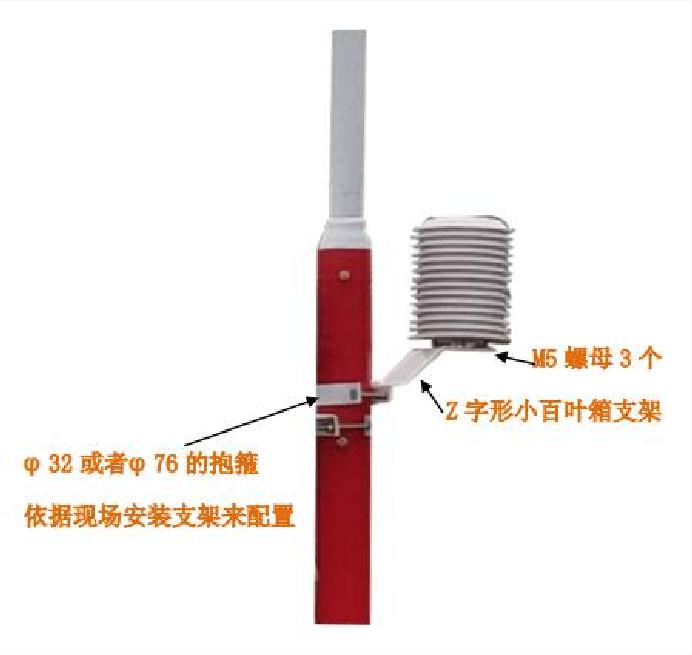
The sensing element must not be exposed to direct sunlight or driving rain; the louvred screen provides the required radiation shield.
Do not wire the sensor while power is applied. Verify all connections before switching on.
The sensor is a precision device — do not dismantle it or allow sharp objects or corrosive liquids to contact the sensing surface.
Keep the calibration certificate for service; return it with the unit if repair is required.