Overview
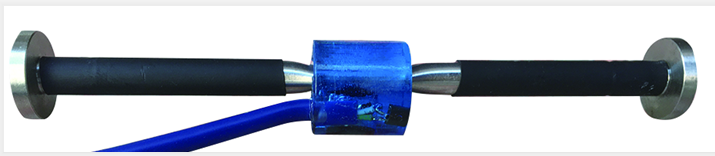
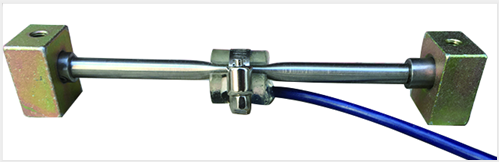
Surface strain gauge CA-BM150
Embedment strain gauge CA-NM150
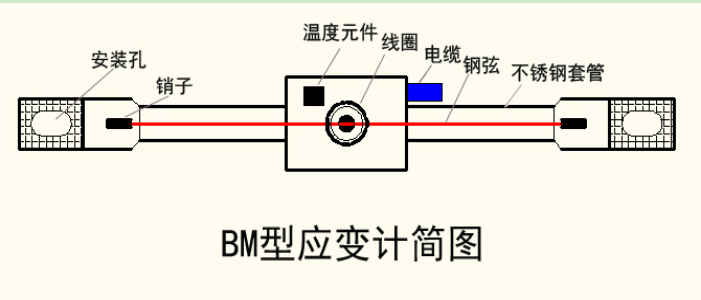
The CA-BM150/NM150 strain gauge is widely used for surface stress and strain measurement of various concrete and steel structures in building foundations across engineering fields such as bridges, metro, railways, airports, dams and wharves, giving a full understanding of the stress state of the member being measured. It offers very high accuracy and sensitivity, excellent waterproof performance and long-term stability. A built-in temperature sensor simultaneously monitors the temperature at the installation position. Frequency and temperature signals are transmitted over a dedicated four-core shielded cable, and the measured values are unaffected by cable length, making it suitable for long-term monitoring of stress and strain changes on the surfaces of concrete and steel structures under various harsh environments.
Its installation methods are diverse: it can be welded, drilled and resin-anchored, or mounted with an accompanying mounting base using AB adhesive, or fixed with expansion screws.
Key Features
- The sensor numbering function gives each sensor a unique "sensor identity number". It is only necessary to record the sensor's installation position and number at the time of installation. No matter what special situation is encountered on site — for example a large batch of wiring harnesses cut during construction, disordered monitoring cables, number stickers rotted after long-term immersion in water, blasting or fire — as long as any wire end of the sensor still exists, the sensor's number can be read out by the instrument to recover its installation position, avoiding unnecessary losses in monitoring.
- The unique identity number makes it easier to store, retrieve and analyse data, and better meets the requirements for integrated automated data measurement and remote data acquisition and monitoring.
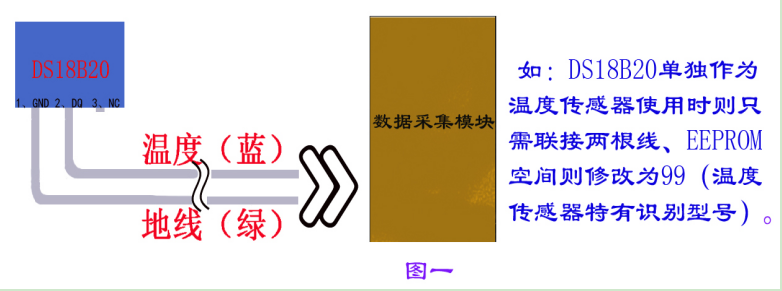
- There is no wire correction in temperature measurement. At present most sensors in China use thermistors for temperature measurement, and with standard monitoring cable there is a corresponding 5-ohm resistance for every 100 metres per direction. If the cable length increases to 300 metres, the thermistor method of temperature measurement must take wire resistance correction into account, whereas the DS18B20 does not need to consider this at all.